|
Exhaust-gas emissions have to fulfill higher and higher standards. Therefore additional software functions, like injector delivery compensation, have been introduced.
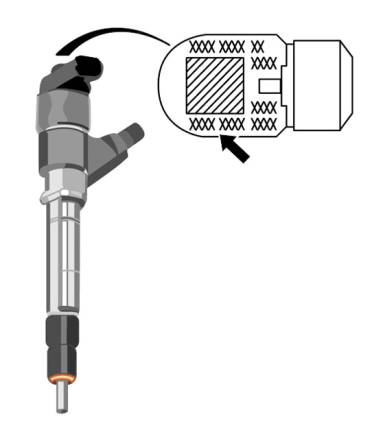
Each injector has different fuel injection characteristics. To optimize the fuel injection performance, the engine control unit compensates for these differences by adjusting the fuel injection duration of the injectors separately. This is based on the unique compensation code, a 30-digit alphanumeric value. Injector compensation codes are printed on the head portion of each injector (Figure 10). When replacing an injector, the compensation code has to be re-programmed in the engine control unit.
Figure 10: Injector compensation code
In addition the smooth-running control adapts the injected fuel quantity per injector to ensure that every cylinder provides the same torque to the crankshaft. If a particular cylinder's speed is too low, the injected fuel quantity is increased and vice-versa.
If the torque of one cylinder is less than the others, the injector of that cylinder receives a longer injector-triggering period. The other cylinders receive a shorter injector-triggering period. These deviations in the injection times can be read with a diagnostic tool. By comparing the readings with the programmed values, the injectors that are not functioning correctly can be identified.
The smooth-running control is limited to the compensation value (Injector delivery compensation) and is make/type dependent. If the correction needs to be higher than this limit, the torque of the specific cylinder will be insufficient. This causes poor running of the engine.
This can be caused by:
- Wrong injector programming: when replacing an injector, the compensation value has to be re-programmed.
- Cavitation: local pressure variations can form temporary vapour bubbles. When these bubbles implode in the subsequent high-pressure phase and contact any surface, this can cause cavitation damage. Replace the defective component.
- Injector contamination: fuel contamination can result in deposits on the injector nozzle. This causes extra resistance during opening and closing of the nozzle. Clean the injector.
- Pressure-relief valve contamination: fuel contamination can result in deposits on the return valve. The outlet won't close completely and the rail pressure will not reach the maximum value. Clean the pressure-relief valve.
- Damage to the injector nozzle due to worn metallic parts, or fuel with very low lubrication characteristics. Replace the defective component.
|