Fuel rail
| Purpose | |
|
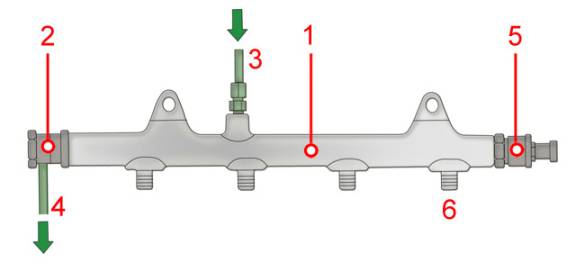
The fuel rail is a high-pressure accumulator, which maintains the fuel at high pressure. This accumulator damps the pulsating effect of the fuel pump and the injection cycles. This ensures the injection pressure remains constant when opening. |
|
| Operation | |
|
The fuel from the high-pressure pump enters the fuel rail. The rail-pressure sensor measures the fuel pressure. Depending on the system configuration, the pressure-control valve limits the fuel pressure in the rail to the maximum permissible pressure. It will also close when the rail pressure is to low (Figure 6). In second- and third-generation common-rail systems there are two methods to control the pressure: a pressure-control valve combined with a metering unit on the high-pressure pump or a metering unit combined with a mechanical pressure-relief valve at the end of the fuel rail (Figure 7). The pressure-relief valve only opens when the fuel rail pressure rises above the maximum allowed pressure, Figure 6: Fuel rail
Figure 7: Fuel rail
|
|