|
|
|
General guidelines for working on high-pressure fuel systems.
- Common-rail diesel injection systems operate at very high pressure. Do not perform any repairs to the fuel injection system with the engine running. Wait
for at least one minute after turning off the engine.
- Pay attention to cleanliness when working on the fuel system. Even the smallest dirt particles in the fuel system can lead to faulty engine operation. Open fuel connections must be sealed off with appropriate covers or plugs.
- Never disassemble fuel injectors.
- Always renew the copper sealing rings of the injectors.
- When replacing an injector, the compensation code has to be re-programmed in the engine control unit.
- When a new engine control unit is fitted, all existing injector compensation codes in the new engine control unit must be set with a diagnostic tool.
- Do not bend or fit high-pressure fuel lines under stress. To prevent leaks, fit new lines when the bends are deformed.
- High-pressure fuel lines are designed for the specific vehicle and are not interchangeable, even when the distances between the common rail and the injectors are the same.
|
|
Always read the general guidelines before working on high-pressure fuel systems.
The advantage of the common rail system is that it can vary the injection pressure and timing over a wide range. The injection pressure is independent of the engine speed and injected fuel quantity. This is achieved by separating the high-pressure pump from the injectors by a pressure accumulator, the common rail.
The engine control unit calculates the injection pressure, the injected fuel quantity and the injection timing, based on the current operating state of the vehicle and using multiple sensors to supply data on:
- Accelerator position
- Crankshaft speed and position
- Engine temperature
- Charge air pressure, etc.
Since its introduction, there have been several improvements to the common rail diesel system. We can therefore identify three generations.
1st generation: Pressure control by a pressure-control valve. Solenoid-valve injector. 1350 bar.
2nd generation: Fuel-delivery control by a metering unit. Solenoid-valve injector. 1600 bar.
3rd generation: Fuel-delivery control by a metering unit. Piëzo injector. CRS3.1 = 1600 bar, CRS3.2 = 1800 bar, CRS3.3 = 2000 bar.
|
|
Overview
|
|
The operation of the system is fundamentally the same in all instances, although the layout can vary considerably depending on the application or manufacturer. Figure 1 shows a typical design for a passenger car common-rail system.
Figure 1: Common-rail fuel system
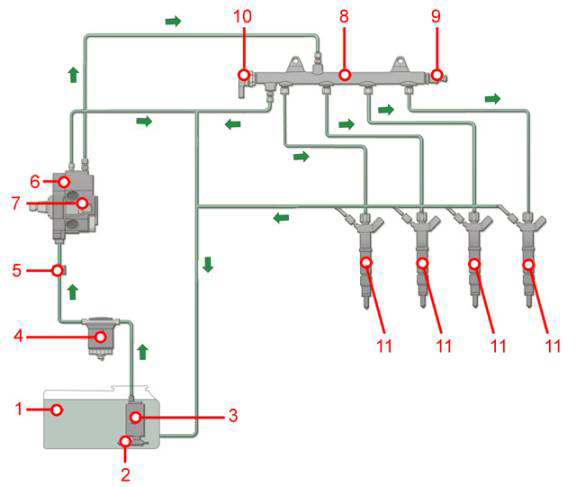
- Fuel tank
- Pre-filter
- Low-pressure pump
- Fuel filter
- Fuel-temperature sensor
- High-pressure pump
- Metering unit
- Fuel rail
- Rail-pressure sensor
- Pressure-control valve
- Injector
|